
Share this article
By Marcia Swank VP, Head of OphthalmologyA decade ago, this was science fiction. This week in Denver, it was the morning agenda.
I’ve just come back from ARVO 2026, the world’s biggest gathering of eye researchers. What I’ve noticed is the industry is shifting: what 10 years ago was unachievable is now the baseline. But as science becomes more “elegant,” the execution becomes more volatile. For sponsors, the era of the “standard” trial is over. Success now demands a deep, granular understanding of therapeutic indications and a willingness to engage in creative partnership modelling, that transcends traditional outsourcing.
What that means, for those of us who design and run the trials is that the operational playbook needs to evolve. Smaller patient populations. Tighter site selection. Longer screening. More imaging, more standardization, more co-ordination with people who weren’t traditionally part of trial operations at all. The science, in a way, is the easy part. The hard part is everything that happens around it.
Here are four takeaways on how the responsibilities of the modern sponsor and CRO are evolving.
1. Recruitment is now a science problem, not a downstream service
The progress in inherited retinal disease (IRD) is genuinely remarkable. Antisense oligonucleotides and gene therapies can now target mutations that were undiagnosable a few years ago. The catch is that none of this works without the right patients and finding them in eye disease is unusually hard.
In precision ophthalmology, sponsors can no longer treat recruitment as something that happens after the protocol is written. It requires a proactive immersion into the patient ecosystem with trusted partners around the table from the start. Two things matter most:
- Creative Partnership Modelling (CPM): Sponsors and CROs need to move past transactional site and vendor relationships toward something closer to an embedded extension, built on shared risk and clear communication. Partnerships built upon deep trust on the agreed objectives, where teams can pivot in real-time, rather than waiting for weeks of contractual change orders. The same applies to relationships with patient registries and advocacy partners.
- Genetic counselling integration: Genetic testing networks and counsellors are becoming a primary pillar of the recruitment conversation, requiring sponsors to manage a more complex, multi-stakeholder consent and identification process.
2. Imaging variability is the silent killer
Every modern ophthalmology trial relies on Optical Coherence Tomography (OCT) — and newer protocols are layering on OCT angiography, adaptive optics and AI-assisted analysis. The technology is extraordinary but the operational complexity of standardizing these readings across global sites is what quietly diminishes data quality.
Different machines, different software versions and different operator techniques all introduce variability and, in a trial, designed to detect a small but meaningful change in retinal structure, that variability can swallow your signal entirely. This is not something to sort out after site activation. It needs:
- Early-stage protocol rigor: Imaging operations are best incorporated into the protocol design stage. Getting consistent readings across sites is genuinely difficult and the work belongs upfront.
- Technical sovereignty: A real understanding of how specific ocular phenotypes interact with imaging modalities is what carries you through regulatory scrutiny at submission. Sponsors who get this right early have a much smoother path through their datasets at analysis, while the ones who do not tend to discover the problem after enrolment, when it is expensive to fix.
3. Fewer visits, more data: what that does to patients
There’s a misconception that precision medicine is easier because it involves fewer injections. Truth is, the trial experience is more demanding. The screening journey (genetic testing, counselling and confirmatory imaging) is a significant burden. Some patients go through the entire process and learn they aren’t eligible. Once enrolled, the visits themselves are denser: more imaging modalities, longer chair time and more data captured per visit. For elderly patients, paediatric patients and patients with progressive vision loss who already find travel difficult, that density matters.
Retention there is no longer just a metric but a design philosophy:
- Hybrid Modelling: To mitigate attrition in small-n cohorts, may need to take creative approaches. This means building home-based assessments, telemedicine touchpoints and local imaging partnerships into the protocol.
- The Burden Balance: Losing even four participants to attrition in a precision trial can be the difference between a clean readout and an uninterpretable study. Sponsors and CROs need take ownership of the patient experience as a clinical necessity.
The sponsors thinking about this at protocol design are seeing better retention, while the ones treating it as a site management problem are seeing dropouts they cannot easily recover from.
4. The five-year horizon needs honesty, not headlines
It’s worth being honest about the gap between headlines and what is actually in the clinic. While RPE65 gene mediated therapies and long dosing anti-VEGFs are here, the “long tail” of rarer mutations presents a daunting regulatory and operational landscape.
Regulators are still defining what “acceptable evidence” looks like for ultra-rare populations, where traditional trial deigns fail. Success requires a partner that doesn’t just follow a checklist, but one that can navigate the gray areas of regulatory requirements with creative clinical trial simulations and real-world evidence (RWE) integration.
The Bottom Line:
Precision ophthalmology has arrived faster than almost anywhere else in medicine and the science deserves the attention it is getting. The operational mandate that comes with it deserves the same.
Sponsors may be better positioned when they move away from vendor management and toward deep-tier partnerships and who understand that the pathway to the patient is just as critical as the therapy itself.
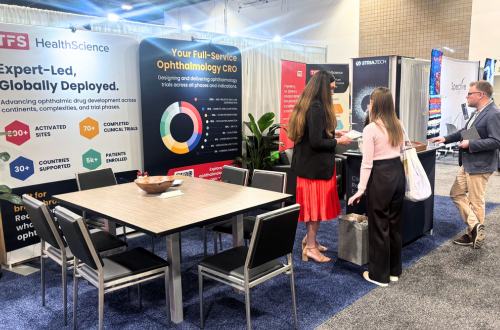
Marcia Swank, Bhakti Patel and Tabitha Schlisserman represented TFS HealthScience at ARVO 2026. If you’re navigating the complexities of a clinical trial program and need an operational partner who has the therapeutic expertise and values creative partnership modelling, please get in touch.
About the Author
Marcia Swank
Marcia is the Vice President, Head of Ophthalmology at TFS, leading global experts in delivering high‑quality ophthalmology clinical programs. She brings 23+ years of experience across clinical research, optometry and ophthalmology operations.