

Share this article
What would you do with five more months?
Five months is the kind of number that is easy to scroll past on a slide. At ESMO 2026 in Madrid, it was the difference in survival in a trial presented at one of the congress’s Presidential Symposia.
Imagine being told your stomach cancer has come back, after two rounds of treatment have already stopped working. In the CLARITY-Gastric01 trial, patients in that position who received standard treatment lived for a median of five months.
The researchers decided to bet on a weak spot. Some of these tumors carry a protein called CLDN18.2. They tested sonesitatug vedotin, an antibody that seeks out CLDN18.2 and carries a chemotherapy payload (MMAE) into the cell. Patients on it lived for a median of 10 months (hazard ratio 0.47, at a planned interim analysis).
A median is not a promise. It is the midpoint of a group: some patients lived far longer, some less. Across everyone in the trial, including patients treated earlier, the gap was 10.6 months against 6.4. And the trial’s other primary endpoint, progression-free survival, narrowly missed significance.
But it was not a one-off. In TroFuse-005, sacituzumab tirumotecan, aimed at TROP2, took median survival in previously treated endometrial cancer from 12.1 months to 19.0 (HR 0.68).
Behind the statistics is something simpler: more time. Time with the people you love. Time to live.
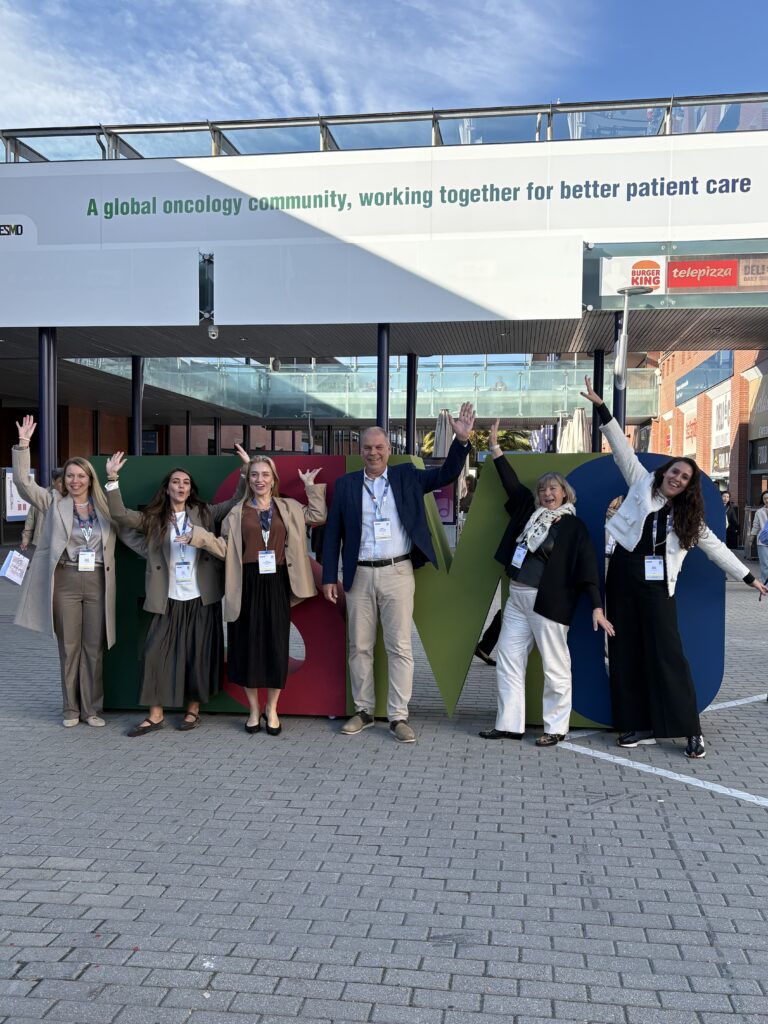
We asked our oncology team what they would do with five more months and what they took away from ESMO – here is what they told us.
What we learned from ESMO and where the field is
Those extra months start years before a congress, in how a trial is designed and run. Here is where the team says that shows up in our work:
- How we turn those months into the way we run trials: Those extra months start years before a congress, in how a trial is designed and run. Each principle below links to something we saw in Madrid.
- Speed is time for patients. Every week lost in start-up or enrollment is a week a patient waits for a treatment that might work. Where standard care offered a median of five months, a delay of weeks is not an administrative detail. Our therapeutic leads hold direct decision-making authority, so questions get answered without climbing an approval chain.
- The patient’s time counts inside the trial. Joining a trial asks a lot: visits, scans, blood tests, travel. KEYNOTE-C93 showed a treatment can work and be easier to live with. Protocols can follow the same logic, with every visit and test earning its place.
- The right sites find the right patients. Only patients whose tumors had CLDN18.2 on at least 25% of tumor cells could join CLARITY-Gastric01. Trials like that screen many patients to enroll each one, so choosing sites that see those patients, and can test for the marker, decides how fast a trial fills. [Example]
- Honest data, good or bad. MOIO’s sponsor stopped the trial when interim data raised concerns. A clear negative answer protects the next patient, and it depends on data collected with the same rigor whether the result is welcome or not.
- The same people from start to finish. 88% of our teams stay for the whole study, 8 percentage points above the industry average. The people who start a trial are still there at database lock.
If you are planning an oncology trial, talk to our oncology team
Sources
AstraZeneca: CLARITY-Gastric01 results, ESMO 2026 abstract LBA7
OncLive: CLARITY-Gastric01 shows OS benefit with sonesitatug vedotin
The ASCO Post: TroFuse-005, abstract LBA11
The ASCO Post: KEYNOTE-C93, abstract LBA12